
About these numbers — please read first
This report works with three distinct datasets, all reported separately so readers can see where each number comes from:
- The Senior Living Malaysia directory (644 listings as of writing, recomputed at every build) — our family-facing index, cross-referenced against operator websites, public registries, and direct correspondence.
- The JKM Pusat Jagaan federal registry (529 senior care centres, May 2026 data) — welfare-grade residential and day-care facilities registered under the Care Centres Act 1993 (Akta 506).
- The MOH/CKAPS medical-grade registries (19 private nursing homes, 4 psychiatric nursing homes, 23 hospices, March–May 2026) — licensed under the Private Healthcare Facilities and Services Act 1998 (Akta 586).
Senior Living Malaysia's directory is broader than any single government registry. It spans both regulators, includes operators registered with Sarawak's state-level Welfare Department (separate from federal JKM), and covers facilities where licensing isn't publicly surfaced but operations have been verified directly with the operator. Our role is to bring these strands together into a single, family-readable index — across both Bahasa Malaysia and English, with parallel Chinese-language guides for cross-border Singaporean families.
Editorial focus disclosure: Singaporean families researching cross-border care are a focus audience for us, and our coverage of Johor (and the multi-branch operators that serve Singapore-facing demand) is denser than population alone would predict.
Seven headline numbers
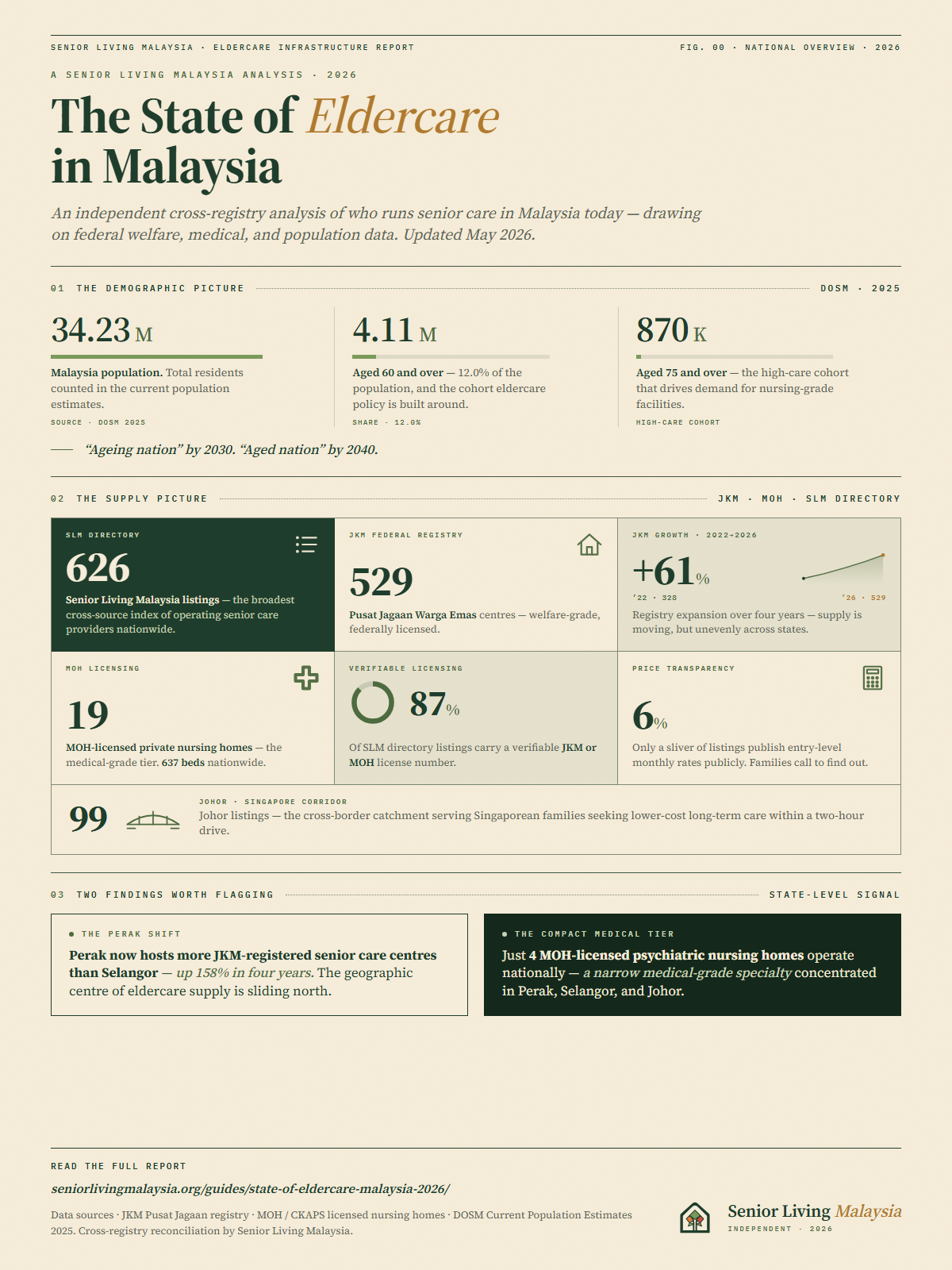
- 644senior care homes in the Senior Living Malaysia 2026 directory as of writing — the most comprehensive cross-source index of Malaysian senior care we know of.
- 529JKM-registered Pusat Jagaan Warga Emas nationally (May 2026), up from 328 in 2022. The welfare-grade residential and day-care tier under Akta 506.
- +61%growth in JKM-registered senior care centres over four years — a publicly-verifiable signal that supply is formalising rapidly.
- 19MOH-licensed private nursing homes nationally (637 beds), the medical-grade tier under Akta 586. A distinct, narrower regulatory regime sitting alongside JKM.
- 86%of our directory listings carry verifiable JKM or MOH licensing tagged from primary sources. 540 carry a JKM record; 16 carry an MOH licence; 5 confirmed dual-licensed.
- 13%of listings publish an entry-level monthly rate (81 of 644). Pricing in Malaysian senior care is, broadly, on-enquiry — particularly across the welfare-grade JKM tier.
- 102Johor listings in our directory (16% of total) — anchored both by Singapore cross-border demand and by our own editorial focus on the JB cluster.
The macro context
Malaysia is on a sharper demographic curve than the country's policy infrastructure is yet built for. Per DOSM's Current Population Estimates 2025, the country had 34.23 million people, of whom 4.11 million (12%) were aged 60 and above and 2.75 million (8%) were aged 65 and above. The high-acuity cohort — Malaysians aged 75 and above — has crossed 870,000 people. Malaysia is on track to be classified an ageing nation by 2030, when seniors aged 60+ are projected to exceed 15% of the population, and an aged nation by 2040 at around 17%.
4.11 million Malaysians are aged 60 and above. The country crosses ageing-nation status by 2030 and aged-nation status by 2040.
Domestically, the Ministry of Women, Family and Community Development launched the Malaysia Care Strategic Framework and Action Plan 2026–2030 in late 2025 — a five-pillar policy aimed at training 50,000 caregivers by 2030 and formalising the care economy as a recognised profession. Externally, Singapore officially crossed the "super-aged" threshold in 2026, with over 21% of its population now aged 65 or older. For middle-income Singapore families above the AIC subsidy threshold, the value gap to a Johor placement remains structurally real — a cross-border dynamic the directory data captures clearly.
Three states already lead on senior share: Perak (14.9% aged 60+), Sarawak (13.4%), and Kedah (13.3%). The geographic distribution of supply — which we turn to next — has not yet caught up to where the population is ageing fastest.
Geographic supply: where the homes actually are
Our directory's state distribution is the family-facing layer. The federal JKM registry shows where formal senior care is registered nationally. The table below shows our coverage; notable gaps and overlaps with JKM's federal data are discussed after it.
| State | SLM listings | Share |
|---|---|---|
| Selangor | 140 | 22% |
| Perak | 113 | 18% |
| Johor | 102 | 16% |
| Penang | 63 | 10% |
| Kuala Lumpur | 58 | 9% |
| Negeri Sembilan | 38 | 6% |
| Kedah | 31 | 5% |
| Pahang | 26 | 4% |
| Melaka | 24 | 4% |
| Sarawak | 18 | 3% |
| Sabah | 17 | 3% |
| Terengganu | 7 | 1% |
| Perlis | 4 | 0.62% |
| Kelantan | 3 | 0.47% |
The top four states — Selangor, Perak, Johor, Penang — account for 65% of our directory. The Klang Valley (Selangor + KL) still leads on density of premium-pricing supply and the professional-family demand that goes with it.
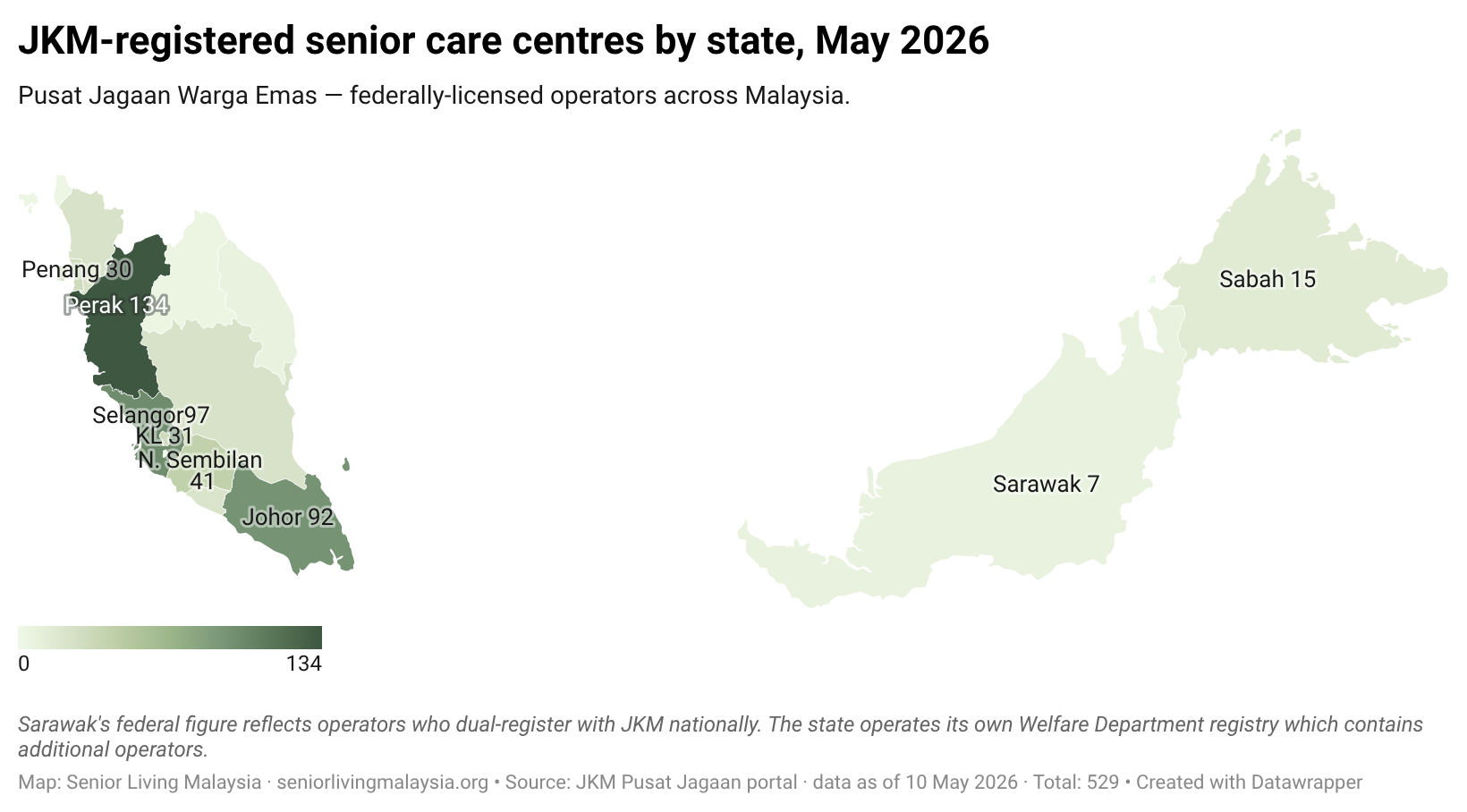
Perak now hosts more JKM-registered senior care centres than Selangor — up 158% in four years.
The Perak finding is the most striking national pattern. The federal JKM registry shows 134 Pusat Jagaan in Perak as of May 2026 — more than any other state, and up from 52 in 2022 (158% growth). At a national level, Perak now hosts more JKM-registered senior care centres than Selangor (97) or Johor (92). Combined with Perak's leading senior-population share (14.9% aged 60+), Ipoh and the Kinta Valley look like a quietly-emerging regional senior-care hub.
Deep dive: why Perak became Malaysia's senior-care growth leader →
Sarawak warrants a methodology note. The federal JKM count for Sarawak is just 7 — disproportionately low relative to the state's population and senior share. Sarawak operates its own state-level Welfare Department (welfare.sarawak.gov.my) and the bulk of Sarawak senior care is registered there, not federally. The federally-listed Sarawak operators are typically the larger or more compliance-oriented ones who dual-register. Our directory carries 18 Sarawak listings drawn from both registries plus operator-direct verification.
Johor is over-represented in our coverage relative to its national share (16% of our directory vs about 17% of JKM nationally). Some of that is our editorial focus on the cross-border corridor; some of it is a real Johor cluster driven by Singapore-facing demand. We come back to this below.
Two regulatory regimes, one market
Malaysian senior care operates under two parallel statutes administered by separate ministries. Families generally meet one or the other depending on the level of care a parent needs.
Federal JKM-registered senior care centres grew 61% in four years — from 328 in 2022 to 529 in May 2026.
Welfare-grade
Care Centres Act 1993, administered by the Department of Social Welfare (Jabatan Kebajikan Masyarakat).
529 Pusat Jagaan Warga Emas nationally (497 residential, 32 day-care).
421 private operators · 107 NGO operators. Five-year registration cycle.
Medical-grade
Private Healthcare Facilities and Services Act 1998, administered by the Ministry of Health via CKAPS.
19 private nursing homes (637 beds).
4 psychiatric nursing homes (137 beds) · 23 licensed hospices.
The regulatory landscape is also consolidating. The Private Aged Healthcare Facilities and Services Act 2018 (Akta 802) was gazetted to unify private aged-care licensing under MOH with higher clinical standards. Its implementing regulations are still working through the pipeline; until they come into force, the JKM (Akta 506) and MOH (Akta 586) split remains the operational regime. This is why a family choosing a Malaysian senior care home today still sees two distinct kinds of badge.
Cross-licensing is rare and clinically deliberate. Of the 19 MOH-licensed private nursing homes, our cross-tab against the JKM 529 registry confirms 5 as dual-licensed (holding both Akta 506 and Akta 586 status): City Heart Care Centre (Johor Bahru), Larut Care Centre (Taiping), Eden On The Park Care Residence (Kuching-Samarahan), Lecadia Primacare (Kuala Lumpur), and Seavoy Nursing Home (Desa Melawati). A further handful of MOH-licensed nursing homes are likely dual-licensed under name-variant JKM records that we could not conclusively link; the remainder appear to operate as MOH-only medical facilities by regulatory choice.
Beyond the two private regimes sit 13 federally-operated government homes (11 Rumah Seri Kenangan + 2 Rumah Ehsan), serving low-income seniors free of charge. The full national supply picture is therefore: federal JKM private/NGO + MOH medical + federal government homes + Sarawak state-level operators + a tail of informal homes outside any registry.
Sitting alongside the regulatory tiers — but distinct from them — is a voluntary industry-association layer. AgeCOPE (the Association for Residential Aged Care Operators of Malaysia) has 330 members representing 538 care centres as at May 2026, according to the association itself. Its public directory lists 148 of those member operators, concentrated in Selangor (40), Penang (31), Kuala Lumpur (22), Perak (19), and Kedah (14), with smaller footprints in Melaka (13), Sabah (6), Negeri Sembilan (6), and Sarawak (1). The directory lists few members in Johor, Pahang, Kelantan, Terengganu, and Perlis. Membership is not a regulatory requirement: many JKM-registered operators choose not to join, and AgeCOPE membership is no substitute for the JKM Perakuan Pendaftaran or an MOH licence. For families, an AgeCOPE listing signals an operator who has opted into peer-review and industry-standards engagement; for journalists, it is a useful third lens on the market but not a regulatory authority.
Deep dives: the welfare-medical divide explained → · Malaysia's inpatient hospice gap →
Licensing visibility for families
Across the Senior Living Malaysia directory, the licensing tag on each listing reflects what we have been able to verify from primary sources (JKM and MOH registries) or operator-supplied evidence.
At 86% verifiable licensing across the directory, Senior Living Malaysia is among the most rigorously sourced family-facing senior care indexes in the region. The remaining 14% are listings where licensing has not yet surfaced from public sources or operator correspondence — typically smaller homes that do not publish registration numbers on their websites. We invite those operators to send a registration certificate in exchange for a Verified ✓ badge; see how we verify listings for the full methodology.
The practical implication for families: licensing is now visible at a glance on most of our listings, but the small minority marked "pending verification" should be sense-checked with the operator before a placement decision. Ask for the JKM Perakuan Pendaftaran or MOH licence number; both are documents the operator is required to hold.
Care-type supply
Most Malaysian operators offer multiple care levels under one roof. The numbers below count facilities that include each care level among their services — most listings appear in more than one row. Families weighing which level fits their parent should start with our choosing the right level of care guide.
- Nursing care (clinical, including MOH-eligible)538 homes
- Assisted living (ADL support, social)197 homes
- Dementia care (cognitive, often secured)124 homes
- Palliative care (comfort-focused)70 homes
- Respite care (short-stay)242 homes
- Independent living (retirement-style)26 homes
Nursing care is the dominant offering, present in about 84% of listings. Dementia care appears in 124 — a meaningful number, though the supply of dedicated secure dementia units remains thinner than the broader "we accept dementia patients" headcount suggests.
The dementia-secure cliff is the most striking supply gap. For Malaysian families whose parent has dementia with severe behavioural or psychological symptoms (BPSD) — the population that needs medical-grade secure psychiatric placement, not a welfare-grade Pusat Jagaan — the formal supply is essentially 4 MOH-licensed psychiatric nursing homes (137 beds) in three states (Perak, Selangor, Johor). Zero facilities in KL, Penang, East Malaysia, or any northern or east-coast state. For most of Malaysia, this is a complete supply gap at the highest-acuity tier.
Independent retirement-style living remains the thinnest segment (26 listings). Malaysia's "retirement village" market is genuinely small; most listings positioned as such are nursing-home operations with a higher-end finish. Growth segments to watch over the next 24 months are dementia-specialist care, hospital-adjacent post-acute rehabilitation, and the first wave of large-format integrated retirement developments coming online in the Klang Valley and Iskandar.
Pricing: still on enquiry
Of the 644 homes in our directory, 81 (13%) publish an entry-level monthly rate. The remaining 563 quote on enquiry. This is the single most consequential consumer-protection issue in Malaysian senior care: families cannot effectively comparison-shop a market that does not publish prices.
Among the 81 listings that publish rates, the mean is RM 3,768/month. These are entry rates — typically shared-room basic care. Add-ons (medications, physiotherapy, doctor visits, hospital escort, incontinence supplies) commonly add RM 500–2,000 monthly depending on the resident's needs. Higher-acuity care (full nursing, dementia-specific units, hotel-style assisted living) sits well above the median; the highest published rates in the directory cross RM 10,000/month.
The 13% publishing rate skews to market-aware operators (chain branches, premium independents, Singaporean-facing JB facilities). Across the full JKM-registered Pusat Jagaan tier — particularly welfare-grade smaller homes and NGO-operated facilities — public rate publication is the exception rather than the norm. For a clearer comparative baseline, see our cost of eldercare in Malaysia guide.
The cross-border arithmetic makes the Malaysian pricing reality particularly relevant for Singapore families: a RM 4,000/month JB nursing home costs roughly SGD 1,180/month — a fraction of comparable private SG rates. See our AIC subsidy vs JB cost analysis for worked examples by Singapore household income band.
The Singapore cross-border dynamic
Editorial note: Singapore families are a focus audience for Senior Living Malaysia, and our Johor coverage is denser than population alone would predict. The numbers below reflect both our editorial focus and the underlying market. The next paragraphs separate the two.
Our directory carries 102 Johor listings (16% of total). Federally, JKM registers 92 Pusat Jagaan in Johor (17% of the national 529). Both numbers point to Johor being a real concentration — not just a directory-bias artefact — driven by a combination of urban-economic factors and Singapore-facing demand.
Several JB operators run Singapore-facing enquiry lines or position explicitly for SG families relocating a parent across the Causeway. The geography helps: most JB facilities sit within a 45-minute drive of the Woodlands or Tuas crossings in normal traffic. Among the JB-cluster trends we observe through 2026: more transparent pricing than Klang Valley peers; a higher concentration of multi-branch operators (Care Concierge, Haywood Living, EHA Eldercare) catering to Singaporean choice; and the emergence of Iskandar Puteri (Medini) as a hotel-style assisted-living node anchored by JCI-accredited Gleneagles Medini.
We expect this segment to grow further as Singapore's super-aged demographics deepen through the late 2020s. Singapore is rolling out new domestic options — the 240 Community Care Apartments at Toa Payoh West (launching October 2026 next to Caldecott MRT) and the S$260M private Perennial Living development at Parry Avenue (RM 30,000+/month equivalent). But for middle-income Singapore families above the AIC subsidy threshold, the value gap to a Johor placement remains structurally real.
Cultural fit signals (early data)
Cultural and dietary alignment is a hard dealbreaker for many Malaysian and Singaporean Muslim, Chinese-vegetarian, and Tamil-Hindu families. We have begun tagging facilities with halal-friendly and prayer-room signals, but the data is sparse — most operators do not publicly state these features even when they accommodate them.
- Halal-friendly (explicitly stated)7 of 644
- Surau / prayer room (explicitly stated)2 of 644
These numbers will grow significantly as operators self-claim and as our outreach pulls explicit confirmations. The pattern across the industry is consistent: halal accommodation is widely practised but rarely marketed. We expect the verified halal-friendly and prayer-room counts to multiply over the next 12 months as awareness of the Muslim-eldercare angle grows among Muslim-positioned operators.
The bottom line
Malaysian senior care in 2026 is a market in the middle of formalising. The JKM federal registry has grown 61% in four years. The MOH medical-grade tier is small but distinct. Senior Living Malaysia's directory of 644 listings — broader than any single government registry — captures the operators that families researching online actually meet, with 86% of listings carrying verifiable JKM or MOH licensing tagged from primary sources. Geographic concentration is loosening as Perak and East Malaysia catch up to the Klang Valley and Johor.
For families, the practical implication is that licensing is now visible at a glance on most listings, but pricing remains opaque across the welfare-grade tier — ask for entry rates plus typical add-ons in writing before committing. For operators, the directory rewards transparency: published rates and clear MOH/JKM evidence cluster more enquiry. For policymakers and researchers, the structural gaps to watch are dementia-secure psychiatric capacity (essentially 4 facilities in three states), pricing publication norms, and the integration of state-level registries (Sarawak) with the federal data. We expect every one of these numbers to shift through 2027 as Singapore's super-aged transition deepens, Malaysia's Care Strategic Framework comes online, and the Act 802 regulatory pipeline progresses.
Methodology and data limits
All numbers in this report are computed at build time from the 644 listings in our directory. Listings are compiled from public registries (CKAPS for MOH, AgeCOPE membership records, JKM-state portals where accessible), operator websites, and direct correspondence with operators where possible. Where licensing or pricing cannot be verified from public sources, the relevant field is marked "unknown" rather than guessed.
National benchmarks are drawn from primary sources, with raw captures stored at research/primary-sources-2026/. JKM data: from the JKM Pusat Jagaan portal as of 10 May 2026 (529 records). MOH data: pulled from CKAPS-published Google Sheets (private nursing homes updated 19 March 2026; psychiatric nursing homes 9 May 2026; hospices 9 May 2026). AgeCOPE data: obtained from agecope.org.my on 12 May 2026 (148 unique members publicly listed; AgeCOPE has confirmed that additional members exist who have not opted in to public directory disclosure, and in September 2026 gave its full membership as 330 members representing 538 care centres, as at May 2026). DOSM demographic figures: Current Population Estimates 2025 preliminary, mid-year tables. Act 506, Akta 586, and Act 802 framework references are drawn from the gazetted Acts and JKM's Panduan Pendaftaran Pusat Jagaan (2020 edition).
Note on AgeCOPE membership counts: Apart from AgeCOPE's own membership total (330 members representing 538 care centres, as at May 2026, provided by the association), all AgeCOPE figures in this report are sourced from the public member directory at agecope.org.my. Operators who self-identify as AgeCOPE members on their own websites, or who appear on third-party platforms, are not counted unless their listing is present in that directory at the time of data collection.
This report has clear limitations. We do not capture every senior care facility in Malaysia — small unlicensed homes and operators without any web presence are systematically under-represented. Sarawak's state-level Welfare Department registry is referenced but not yet fully integrated into our directory. The published-pricing sample (n=81) reflects market-aware operators and is not representative of the welfare-grade tier where on-enquiry quoting is the norm. The 5 confirmed dual-licensed (MOH + JKM) figure is a floor, not a ceiling: name-variant matching against the full JKM registry is ongoing.
We update this report as the directory grows and as primary sources are refreshed. If you operate a senior care facility in Malaysia and want to be listed — at no charge — please get in touch. For the full per-field verification methodology, see how we verify listings.
For media, researchers, and operators
Citations of this report are welcome. Please link back to seniorlivingmalaysia.org/guides/state-of-eldercare-malaysia-2026/ as the source, and cite as "Senior Living Malaysia, State of Eldercare in Malaysia 2026". For specific data extracts, custom regional breakdowns, raw CSVs from the primary-sources folder, or interviews with our team, contact us directly. We are happy to support journalists, academic researchers, and policy work.
Cite this report
Senior Living Malaysia (2026). State of Eldercare in Malaysia 2026. seniorlivingmalaysia.org/guides/state-of-eldercare-malaysia-2026/
Press kit — direct downloads
- · Portrait infographic (PNG, 1200×1600) — full report cover, for embeds in articles or print
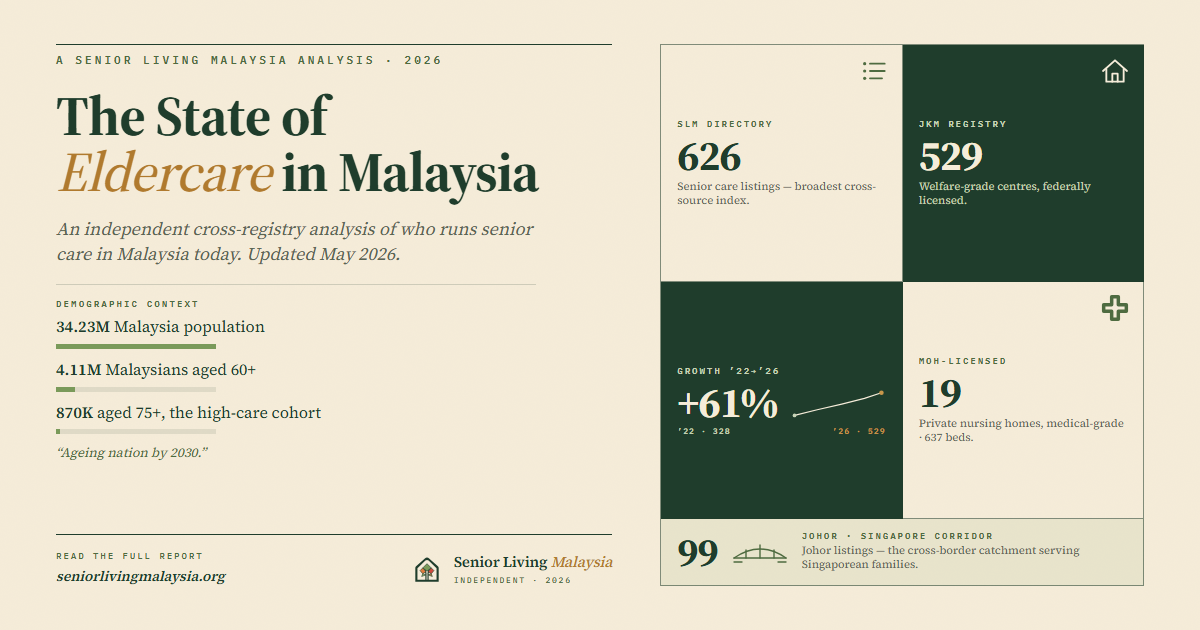
- · Landscape OG card (PNG, 1200×630) — social-share format, for Twitter cards and LinkedIn previews
- · JKM state choropleth map (PNG) — interactive version at datawrapper.dwcdn.net/JIpf3/1/
- · Source HTML — for republication or adaptation (please credit Senior Living Malaysia)
Related guides
Why Perak leads Malaysia in senior care
Perak now has more JKM-registered care centres than any state, up 158% in four years. What is driving the Kinta Valley rise.
The welfare-medical divide in eldercare
Malaysia has 529 welfare-grade JKM care centres but only 19 MOH-licensed medical nursing homes. Why the split exists and what it means.
Malaysia's inpatient hospice gap
Just three licensed inpatient hospices, 33 beds in all, serve 4.11 million Malaysians aged 60+. What it means for end-of-life care.
Related
- · Choosing the right level of care — independent, assisted, nursing, dementia, respite, palliative
- · MOH licensing vs JKM registration — what they mean
- · Cost of eldercare in Malaysia — state-by-state breakdown
- · Senior care cost comparison: Malaysia vs Singapore
- · AIC subsidy vs JB nursing home cost
- · Nursing homes in Johor Bahru — guide for Singaporean families
- · Muslim eldercare in Malaysia — halal kitchens and prayer space
- · Respite care and short-stay nursing homes in Malaysia
- · Senior day care in Malaysia
- · 马来西亚养老院指南 (Mandarin)
- · 送父母进老人院的决定 (Mandarin — family decision guide)
- · Browse the full directory